Every day, women in your city open Google and type phrases like “best gynecologist near me” or “OB-GYN clinic for prenatal care.” The doctor who shows up first, earns their trust online, and makes booking effortless — wins the appointment. Without a strong marketing plan for gynecologists, most clinics never even get noticed, let alone chosen.
This document changes that. What follows is a complete, phase-by-phase marketing plan for gynecologists — the same framework iDigital Doctor uses when onboarding a new OB-GYN practice client. Work through it in order. By the end, you will have a fully documented plan you can begin executing this week.
Practice Audit & Situation Analysis
No marketing plan should begin with tactics. It must begin with an honest assessment of where your practice stands today. This audit takes approximately 45 minutes to complete and forms the foundation of every decision that follows.
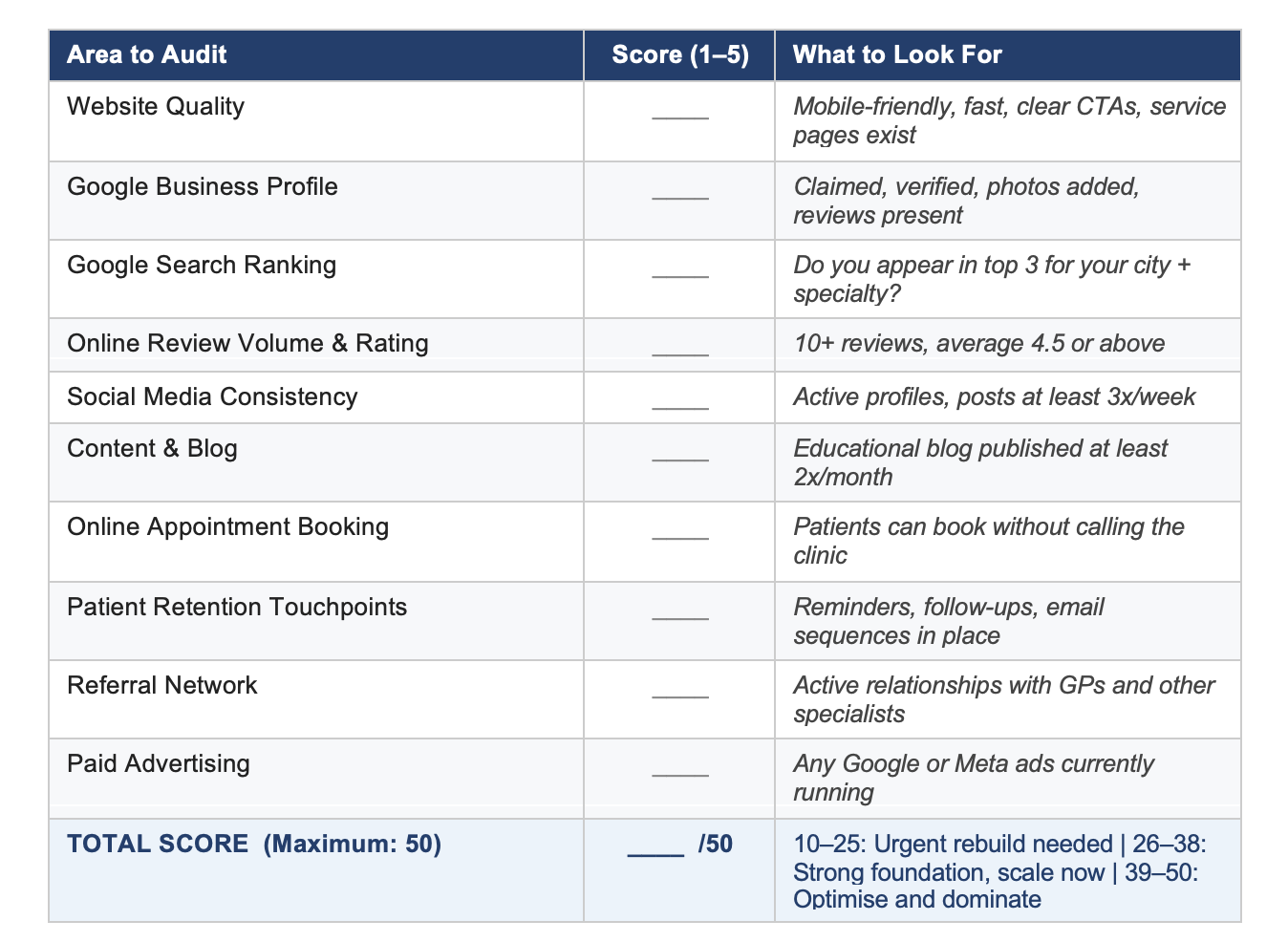
1.1 — Complete Your Practice Scorecard
Rate your practice honestly from 1 (poor) to 5 (excellent) across each area below. This is your baseline. You will revisit this scorecard at the 90-day mark.
1.2 — Know Your Patient: Build Your Personas
Before spending a single rupee on marketing, you need absolute clarity on who you are marketing to. A patient persona is a research-based profile of your ideal patient. For a gynecology practice, you will typically serve three to five distinct groups:
| Persona | Age & Stage | Her Primary Concern | What Wins Her Trust |
| First-Time Mother | 22–34, Pregnant or planning | Am I and my baby safe? Will the doctor listen to me? | Empathetic content, prenatal care guides, patient stories |
| Fertility Seeker | 28–42, Trying to conceive | Do they have real IVF/infertility expertise? What are success rates? | Clinical credentials, specialist experience, hope-led messaging |
| Routine Care Patient | 18–45, Annual checkups | Is the clinic convenient, affordable, and easy to book? | Online booking, clear pricing, fast appointment availability |
| PCOS / Hormonal Health | 20–38, Managing condition | Does this doctor truly understand PCOS or just prescribe pills? | Condition-specific content, treatment plans, long-term care approach |
| Perimenopause / Menopause | 45–60, Managing transition | Will they take my symptoms seriously and not dismiss me? | Specialist knowledge, warm tone, educational resources |
| ⚡ Your Action Step Print the scorecard above. Fill it in completely and honestly. Circle your three lowest-scoring areas — those become your Phase 3 priorities. Do this before reading further. |
Set Your SMART Marketing Goals
A plan without goals is just activity. Before executing anything, define exactly what success looks like for your practice. Use the SMART framework — Specific, Measurable, Achievable, Relevant, Time-bound — and complete the goal-setting worksheet below.
2.1 — Your Goal-Setting Worksheet
Fill in the blanks for each goal category. Be specific. Vague goals produce vague results.

Women seeking OB-GYN care are often navigating the most emotionally significant moments of their lives — first pregnancies, fertility challenges, menopause, or sensitive reproductive health concerns. They choose a doctor they will trust with intimate aspects of their wellbeing. This means your marketing is less about promotion and more about reassurance, credibility, and empathy. Every strategy in this plan is built around that reality.
Build Your Foundation — Website, Local SEO & Google Business Profile
No paid advertising or social media campaign will deliver sustainable results without a strong digital foundation. Phase 3 is about making sure the basics are completely locked in before you invest in promotion. Many practices skip this phase and wonder why their ads aren’t converting. The answer is almost always a broken foundation.
Your Website Must Do One Thing Above All Else
Your website’s job is not to look impressive. Its job is to convert a visitor into a booked patient. Every design decision, every piece of content, every button placement should serve that single purpose. For a gynecology practice, the non-negotiables are: mobile-first design (over 70% of healthcare searches happen on mobile), page load speed under 3 seconds, dedicated service pages for each of your specialties, a prominent online booking system, a real doctor biography that builds personal trust, patient testimonials, and a comprehensive FAQ page.
That FAQ page deserves special mention. When you answer the 25–30 most common questions your patients ask — “What should I expect at my first appointment?”, “Is PCOS treatable?”, “When should I start prenatal care?” — each answer becomes a page that can rank on Google and draw in patients who are actively searching for that information. This is free, compounding patient acquisition that requires no ad spend.
Local SEO: The Highest-ROI Channel Available to You
When a woman types “gynecologist near me” into Google, the three practices that appear in the local map pack at the top of results capture the overwhelming majority of clicks. Getting into that 3-pack — and staying there — should be your single biggest marketing priority in the first 90 days.
The most important factor in local SEO is your Google Business Profile. Most gynecology practices have a GBP that is claimed but nowhere near fully optimised. Your profile should have your correct primary category (“Obstetrician-Gynecologist,” not just “Doctor”), all your services listed with keyword-rich descriptions, a minimum of 15 high-quality photos, Google Posts published twice a week, your Q&A section seeded with relevant questions and your own answers, messaging enabled, and a consistent flow of new patient reviews. Each of these elements signals to Google that your practice is active, authoritative, and locally relevant.
Beyond your GBP, local SEO requires consistent NAP information — your Name, Address, and Phone number must be identical across every directory. Inconsistencies confuse Google and suppress your rankings. Ensure your practice is listed correctly on Practo, Justdial, Lybrate, and any other relevant local health directories in your city.
Your Three-Tier Keyword Strategy
Think about the keywords your patients search in three tiers. Tier 1 keywords are your local primary terms — “gynecologist in [City],” “best OB-GYN [City]” — and these belong on your homepage and GBP listing. Tier 2 keywords are service-specific — “PCOS doctor [City],” “infertility specialist near me,” “prenatal care gynecologist” — and each one deserves its own dedicated service page on your website. Tier 3 keywords are informational — “signs of PCOS,” “when to see a gynecologist,” “first trimester pregnancy symptoms” — and these are the territory of your blog and FAQ page.
YOUR ACTION STEP — Do This Today
Log into your Google Business Profile. Go through every section systematically and complete anything that’s missing or outdated. Add photos if you have fewer than 10. Write your first Google Post — a short health tip or appointment availability update. This takes 45 minutes and will improve your local ranking within weeks.
✅ DIY — Free & Do Today
Fully complete your GBP using the checklist above. Install Google Analytics 4 and Search Console on your website (both free). Identify your top 5 service keywords and check if you have dedicated pages for each. If not, create them.
We handle full technical SEO — schema markup, Core Web Vitals optimisation, local citation building across 30+ directories, GBP management, keyword research, and monthly ranking reports. Your practice climbs the rankings while you focus on patients.
Patient Acquisition — Content Marketing, Social Media & Paid Ads
With your foundation in place, Phase 4 activates the channels that drive a consistent, measurable flow of new patient enquiries. This is where most practices start — and why they waste money. Foundation first, acquisition second. Always.
Content Marketing: The Only Channel That Compounds Over Time
A blog post you publish today can generate patient enquiries every month for the next three years. Paid ads stop the moment you stop paying. Content does not. The goal is simple: for every question your ideal patient types into Google, your practice should have the most helpful, accurate, and trustworthy answer — published on your website.
Focus your first 90 days of content on four patient personas. For first-time mothers, publish comprehensive prenatal care guides, what to expect at each trimester, and questions to ask your OB-GYN. For PCOS patients, write deeply about symptoms, hormonal treatment options, and lifestyle management — this audience is highly engaged and underserved by thin content. For fertility seekers, address infertility causes, IVF basics, and when to seek specialist help. For menopause patients, cover hormonal changes, treatment options, and mental health — an audience that is growing rapidly and actively searching.
Every blog post should be a minimum of 1,500 words, medically accurate, written in accessible language, and optimised for a specific keyword. Google’s YMYL (Your Money or Your Life) guidelines apply strictly to healthcare content — thin, inaccurate, or low-credibility content will actively hurt your rankings. Quality is non-negotiable.
Social Media: Platform-by-Platform Strategy
Instagram is your primary platform for reaching women aged 22–42. Post educational carousels (infographic-style posts explaining conditions like endometriosis or PCOS), short Reels where the doctor answers common patient questions, and health awareness content tied to nationally recognised days like World Breastfeeding Week or Cervical Cancer Awareness Month. Aim for 4–5 posts per week and daily Stories. Consistency matters far more than occasional viral moments.
Facebook remains dominant among women aged 35–60 and is powerful for building a patient community. Consider creating a Facebook Group for women’s health in your city — this positions your practice as a community resource, not just a clinic. Run monthly Facebook Live Q&A sessions with the doctor. These consistently generate the highest organic reach of any format on the platform.
YouTube is the most underused channel by gynecologists and the one with the longest ROI. A library of 20–30 procedure explainer videos, patient FAQ videos, and condition deep-dives can generate hundreds of monthly patient enquiries organically — for years — with no ongoing cost. Even one video per month adds up quickly. Start with a simple doctor introduction video and your top 5 patient FAQ answers.
LinkedIn serves a different purpose entirely: building your referral network among GPs, endocrinologists, and paediatricians. Post clinical insights, specialty updates, and professional achievements. This keeps you visible to colleagues who make referral decisions.
Paid Advertising: Immediate Results While SEO Builds
SEO delivers compounding results over 3–6 months. Google Ads and Meta Ads deliver results from Day 1. The critical principle for OB-GYN Google Ads is campaign separation: create individual campaigns for Prenatal & Obstetrics, Fertility & IVF, PCOS & Hormonal Health, and General Routine Care. Each campaign uses service-specific keywords and — this is non-negotiable — links to a dedicated service landing page, not your homepage. This single change can double your conversion rate overnight.
On Meta, your most effective campaigns will be video ads featuring the doctor speaking directly to patients, retargeting campaigns reaching website visitors who didn’t book, and Lookalike Audience campaigns built from your existing patient email list. Avoid generic stock photo ads — they perform poorly in healthcare because they lack the personal trust signal that drives patient decisions.
YOUR ACTION STEP — Do This Today
Write your first blog post on one of these topics: “What to Expect at Your First Gynecology Appointment” or “10 Signs You Should See a Gynecologist.” Aim for 1,500 words, structure it with clear H2 subheadings, and include your city name naturally in the content. Publish it this week. This is the beginning of your SEO content engine.
✅ DIY — Free & Do Today
Write 1 blog post per week. Use Canva (free) for social media graphics. Batch-create 12 Instagram posts in one sitting using the free Meta Business Suite scheduler. Record a 2-minute doctor FAQ video on your phone and upload it to YouTube.
We manage your full content calendar, social media, Google Ads campaigns, and Meta advertising — with HIPAA-compliant content, medical review, keyword targeting, A/B testing, and weekly performance reporting — all under one roof.
One of the most common questions gynecologists ask is: how much should I actually spend on marketing? The honest answer depends on your city’s competitiveness, your practice size, and your growth goals. Here’s a realistic framework across three tiers.
Figures are indicative and may vary by city competitiveness and practice size.
Patient Retention, Reputation Management & Referral Systems
Acquiring a new patient costs 5 to 7 times more than retaining an existing one. Yet most gynecology practices invest almost nothing in retention. Phase 5 builds the systems that turn one-time patients into lifelong advocates — and advocates into a consistent stream of referrals.
Build a Review Generation System This Week
Your Google review count and average rating directly influence your local search ranking. More importantly, they influence whether a woman researching gynecologists chooses to call your clinic or your competitor’s. The good news is that most patients are happy to leave a review — they simply aren’t asked at the right moment or made it easy enough to do so.
The system is straightforward. Get your Google review short link from your GBP dashboard. Create a WhatsApp message template: “Dear [Name], thank you for visiting us today. If you had a positive experience, we’d be grateful if you could share a quick Google review here: [link]. It takes 60 seconds and helps other women find quality care.” Train your front-desk team to send this message to every patient within two hours of their appointment. Set a team target of minimum three new reviews per week. Respond to every review — positive and negative — within 24 hours, without ever mentioning patient names or clinical details (this is a HIPAA requirement).
This system costs nothing, takes one afternoon to set up, and will add 50+ Google reviews in 90 days if followed consistently. It is the single highest-impact free action available to any gynecology practice.
Automate Your Patient Communication
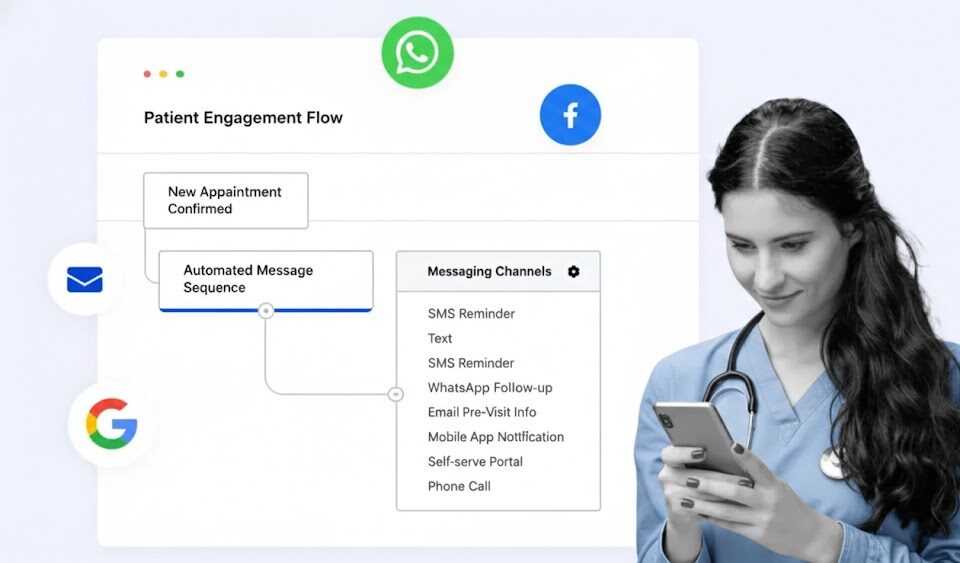
Most practices lose patients between visits simply because there’s no communication in between. A basic automation sequence — appointment confirmation, 48-hour reminder, same-day reminder, post-visit follow-up, and annual checkup nudge — reduces no-shows by up to 30% and significantly increases rebooking rates. These sequences can be set up in any modern practice management system or through a simple WhatsApp Business account. Once built, they run automatically with zero ongoing effort.
Build a Physician Referral Network
The most reliable patient acquisition channel that almost no OB-GYN practice markets deliberately is physician referrals. A structured relationship with GPs, endocrinologists, and paediatricians within 5km of your practice can become your single largest source of new patients — and unlike paid ads, these patients arrive with built-in trust because they were recommended by someone they already know and trust.
Start by identifying 10 GP clinics near your practice. Call them, introduce yourself, and ask for a brief 10-minute visit. Bring a simple one-page referral information sheet covering your specialties, availability, and how to refer patients. Follow up every referred patient’s treatment with a timely clinical feedback letter to the referring doctor — this is the single most effective way to ensure that doctor refers patients to you again. Consider hosting a quarterly clinical dinner or CME event for referring physicians to maintain the relationship over time.
YOUR ACTION STEP — Do This Today
Get your Google review short link right now from your GBP dashboard. Write your WhatsApp review request message. Send it to the last 10 patients you saw. Even if just 3 of them respond, that’s meaningful progress on your reputation within 24 hours.
✅ DIY — Free & Do Today
Set up your Google review link, write your WhatsApp review request, and train your front desk. Identify 10 local GP clinics and visit them with a referral information sheet. These two actions together cost nothing and can produce measurable results within weeks.
We implement a fully automated review generation system — SMS + WhatsApp + email sequences triggered post-appointment — with negative review interception, response management, competitor review monitoring, and monthly reputation reports.
Phase 6 of 6 — The Most Important Section
Your 90-Day Week-by-Week Execution Roadmap
Everything in Phases 1–5 is strategy. This is execution. The roadmap below tells you exactly what to do and when — so there is no ambiguity, no analysis paralysis, and no reason to delay. Work through it in sequence. Don’t skip ahead.
WEEK 1: Audit, Setup & Foundation
Focus: Complete your audit and get the basics right before spending anything on promotion.
- Complete the 5-point practice audit from Phase 1. Write down your three biggest gaps.
- Audit your website against the checklist — mobile speed, service pages, booking system, FAQ.
- Fully optimise your Google Business Profile using the 12-point checklist.
- Set up Google Analytics 4 and Google Search Console if not already done.
- Set up your WhatsApp review request message. Train front-desk. Start collecting reviews today.
- Identify 10 GP clinics within 5km. Call and schedule introduction visits this week.
- Fill in your KPI dashboard baseline numbers in Google Sheets.
WEEKS 2–3: Content & Social Media Launch
Focus: Get your first content assets live and social media operational.
- Write and publish your first two blog posts from the 90-day content calendar.
- Set up or refresh Instagram and Facebook business profiles — bio, contact details, booking link.
- Batch-create 12 social media posts using Canva. Schedule them using Meta Business Suite (free).
- Record your first YouTube video — doctor introduction or answering top 3 patient FAQs.
- Set up appointment reminder messages in your practice management software or WhatsApp Business.
- Complete your GP clinic introduction visits. Leave referral information sheets.
WEEKS 3–4: Paid Ads Launch & First Numbers Review
Focus: Launch your first paid campaign and review what your first month’s data reveals.
- Launch your first Google Ads campaign for your highest-priority service with a budget matching your tier.
- Verify every ad links to a dedicated service landing page — not the homepage.
- Publish blog posts 3 and 4 from your content calendar.
- Review your KPI dashboard. Record Week 4 numbers against baseline. Note what’s moving.
- Check GBP Insights: how many searches, profile views, and calls came in this month?
- Follow up with the first 10 GP clinics you visited.
MONTH 2: Scale What’s Working, Fix What Isn’t
Focus: Use your first month’s data to double down on your best-performing channels.
- Publish all 4 Month 2 blog posts from your content calendar.
- Review Google Ads: pause underperforming keywords. Increase budget on top-converting ad groups.
- Launch your second Google Ads campaign for your second-priority service.
- Host your first Facebook Live Q&A session — announce it 5 days in advance on your page.
- Publish your Month 2 YouTube video.
- Send your first monthly email newsletter to your existing patient database.
- Review competitor GBP profiles — are they outranking you? What do they have tha
MONTH 3: Optimise, Expand & Lock In Results
‘Focus: Turn early momentum into a sustainable, repeatable patient acquisition machine.
- Publish all 4 Month 3 blog posts including your local authority content piece.
- Launch an Instagram Reels series — 4 short videos of the doctor answering common questions.
- Launch a Meta retargeting campaign targeting website visitors who didn’t book an appointment.
- Activate a Lookalike Audience campaign based on your existing patient email list.
- Host your first physician referral dinner or clinical update breakfast.
- Complete your 90-Day Review: fill in KPI dashboard with Month 3 numbers vs. baseline.
- Identify your top 3 performing blog posts. Plan follow-up content on related topics for Month 4–6.
MONTH 3: Optimise, Expand & Lock In Results
If you execute this roadmap consistently, you should expect to see: your practice appearing in the local Google 3-pack for your primary city keyword, 30–50+ new Google reviews, measurable growth in website enquiries, a functional content library of 12 published blog posts, active social media accounts with growing local audiences, at least 5 active GP referral relationships, and most importantly a measurably higher volume of new patient appointments than when you started.
Why iDigital Doctor is best for your Clinic Marketing
iDigital Doctor — India’s Healthcare-Exclusive Digital Marketing Agency
Reading this plan is the first step. Executing every phase consistently — while running a full patient schedule, managing staff, and delivering clinical care — is where most practices stall. That is exactly the gap iDigital Doctor was built to fill.
We are a healthcare IT and digital marketing agency built exclusively for the medical industry. Every strategy we deploy, every content piece we create, and every rupee of ad spend we manage is purpose-built for healthcare professionals — not adapted from generic marketing playbooks designed for clothing brands or food delivery apps.

Page-1 rankings for your city and specialty keywords. Medically accurate, YMYL-compliant, E-E-A-T-optimised content strategy with full technical SEO and GBP management.

Social Media Marketing
Full-calendar content management across Instagram, Facebook, and YouTube. HIPAA-aware content, graphic design, scheduling, community management, and monthly reporting.

Google Ads / PPC
ROI-focused campaigns structured by service. Keyword research, dedicated landing pages, A/B testing, bid optimisation, and weekly reporting — zero wasted spend.

Website Design for Doctors
Mobile-first, fast healthcare websites with built-in SEO, schema markup, online booking, HIPAA-compliant forms, and patient testimonials — designed to convert visitors into appointments.
The iDigital Doctor Difference
- Healthcare-exclusive expertise — we never dilute our focus across other industries
- We understand YMYL, E-E-A-T, HIPAA and Practo — no need to explain healthcare context to us
- Full-funnel strategy: SEO + Ads + Social + Website under one roof, fully integrated
- Dedicated account manager who knows your specialty, not a rotating junior team
- Transparent monthly reporting with real KPIs — new patients, cost per lead, ranking movement
- Free practice marketing audit for every new client — no commitment, no sales pressure
Want This Plan Executed For You?
Our team executes a proven marketing plan for gynecologists designed to position you as the trusted choice in your area and consistently drive qualified patient inquiries.

Conclusion: A Plan Only Works If You Work It
You now have what no competitor blog will give you — not a list of tips, but a complete, phase-by-phase marketing plan for your gynecology practice. From the practice audit in Phase 1 to the week-by-week execution roadmap in Phase 6, every section of this guide is designed to be acted on, not just read and closed.
The practices that will dominate local search, fill their appointment books, and build lasting patient loyalty in 2025 are not necessarily the most clinically experienced ones. They are the ones that combine clinical excellence with consistent, strategic marketing execution.
Start with Phase 1 today. Complete the audit. Fill in your KPI dashboard. Optimise your Google Business Profile. Write your first blog post. Each step, done consistently, compounds into results that no competitor who’s still just “thinking about marketing” can match.
And if you want a team that executes this plan for you — with healthcare expertise, transparent reporting, and zero learning curve — iDigital Doctor is ready to help.