Why This Plan Is Written in Plain Language — On Purpose
Most marketing guides for nephrologists are written by agencies trying to impress you with complexity. This one is written to actually help you. Every strategy is explained simply enough that you could explain it to your clinic manager. Every action step is specific enough that you could start it this week.
If you are a nephrologist who wants to grow your practice, reduce your dependence on word-of-mouth referrals, and build a predictable system for attracting new kidney patients — this plan is for you. You do not need to understand digital marketing. You just need to follow the steps.
Why Nephrology Marketing Is Genuinely Different From Other Specialties
Understanding this section will save you from wasting money on the wrong strategies. Kidney patients search differently, think differently, and make decisions differently. Your marketing must reflect this.
Nephrology has a marketing challenge that almost no other specialty faces at the same scale — and most marketing agencies never understand it. Here are the three things that make it unique.
Most CKD patients do not know they have kidney disease
Chronic Kidney Disease (CKD) is called a “silent disease” because it has almost no symptoms in the early stages. Your potential patients are not searching for a nephrologist — they are searching for what their elevated creatinine means, or why their feet are swollen, or why their urine looks foamy. Your marketing must intercept them at this early symptom stage, not just when they are ready to book a specialist.
-
Most CKD patients do not know they have kidney disease
Chronic Kidney Disease (CKD) is called a “silent disease” because it has almost no symptoms in the early stages. Your potential patients are not searching for a nephrologist — they are searching for what their elevated creatinine means, or why their feet are swollen, or why their urine looks foamy. Your marketing must intercept them at this early symptom stage, not just when they are ready to book a specialist.
-
CKD patients are often afraid — and that fear makes them avoid care
When people hear the words “kidney specialist,” many immediately think of “dialysis.” This fear — that seeing a nephrologist means they are “bad enough to need dialysis” — causes many patients to delay seeking care even when they know something is wrong. Your marketing needs to actively reduce this fear. A patient who comes to you early is a patient you can help the most.
-
Many of your patients come from other doctors, not from the internet alone
Unlike dermatologists or dentists, nephrologists receive a significant proportion of patients via GP referrals, diabetologist referrals, and cardiologist referrals. This makes your referral network one of your most important marketing assets — and one that most marketing plans completely ignore.
Your Five Types of Kidney Patients — and What Each One Needs
Not all kidney patients are the same. A person with newly elevated creatinine needs very different information than a dialysis patient seeking a second opinion. Understanding your patient types helps you create the right message for the right person at the right time.
-
The Worried Lab-Report Patient
Just received a blood test showing high creatinine or low GFR. Scared and confused. Searching urgently to understand what it means and whether they need a specialist.
-
The Symptom Searcher
Experiencing foamy urine, swollen feet or ankles, persistent fatigue, or frequent urination at night — but hasn’t connected these to kidney disease yet.
-
The Referred Diabetic Patient
Type 2 diabetic sent by their endocrinologist or GP for kidney evaluation. Protein in urine or declining GFR. Often elderly, often with a family member who brings them.
-
The Caregiver / Family Member
Adult child or spouse researching on behalf of an elderly parent with CKD or kidney failure. Often makes the appointment decision. Needs reassuring, clear content.
-
The Advanced CKD / Transplant Patient
Already diagnosed with advanced CKD or kidney failure. Seeking specialist management, pre-transplant evaluation, or a second opinion on their care plan from another doctor.
-
Before We Begin
Know your patient mix before spending on marketing
Look at your last 30 new patient enquiries and count how many fall into each type above. Which type is most common? Which generates the best long-term patient relationships? Your answer tells you where to invest first.
The Fear of Dialysis — Why Patients Avoid You Even When They Need You
This is something no other nephrology marketing guide has ever addressed: the specific psychological reason kidney patients delay care, and how to design your marketing to reduce that barrier.
Here is a difficult truth: many people who have elevated creatinine levels, protein in their urine, or early-stage CKD will avoid seeing a nephrologist — even when their GP has recommended it. The reason is almost always the same: they are afraid that seeing a kidney specialist means they are “bad enough to need dialysis.”
This fear costs your practice patients who genuinely need your care. And it costs them their health — because the earlier you see a CKD patient, the more you can do to protect their kidney function and slow disease progression. Your marketing must address this fear head-on.
Your homepage headline and Google Ads copy should emphasise protecting kidney function, not managing kidney failure. “Protect Your Kidneys Before Problems Develop” attracts far more early-stage patients than “Kidney Disease Treatment Centre.”
A blog post titled “What Your Creatinine Level Actually Means — And When You Really Need to See a Specialist” — written in plain language — will rank highly for anxious patients who have just received abnormal lab results. It positions you as reassuring and trustworthy rather than alarming.
For fear-sensitive patients, “Book Now” can feel too confrontational. Try “Chat with Us on WhatsApp — No Commitment Needed” or “Ask Us About Your Kidney Test Results.” These lower the psychological cost of making the first contact and convert patients who would otherwise leave without enquiring.
Symptom-First SEO — How Kidney Patients Actually Search Google
This is the strategy that most nephrologists are completely missing. Once you understand it, you will immediately see why your competitors are invisible to the majority of potential kidney patients — and how to fix that for your own practice.
Most nephrologists think about SEO like this: “I need to rank for ‘nephrologist in [City].'” This is correct — but it only reaches patients who already know they need a specialist. That is a small fraction of your potential patient pool. The much larger opportunity is to rank for what kidney patients search before they know they need a specialist — their symptoms and their lab results.

-
Simple Rule to Remember
Write one blog post per week from Stage 1 and Stage 2 keywords. These articles bring patients to you early — before they find your competitors. Your Stage 3 pages (your website service pages) then convert them when they are ready to book. Both are essential. Most practices only have Stage 3 coverage.
Your Website & Local SEO — Getting Found When It Matters Most
Your Google Business Profile is often the first thing a patient sees when they search for a nephrologist — it appears before your actual website. Getting it right takes less than 90 minutes and is one of the highest-impact actions you can take for free.
Google Business Profile — Fix This First

Essential Condition Pages Your Website Must Have
Every major condition you treat needs its own dedicated page — not a bullet point on a single “Services” page. A single page listing CKD, dialysis, transplant, and hypertensive nephropathy cannot rank for any of them. Each needs its own page with its own keyword, its own patient-specific content, and its own CTA.
Explain the stages simply. Address the dialysis fear directly. Include what your treatment approach involves and what patients can expect at their first appointment.
India’s largest single source of CKD. Cover how diabetes damages kidneys, when a diabetic patient needs a nephrologist, and how you work alongside their diabetologist.
High search volume, strong local intent. Cover types of stones, prevention, management, and when a nephrologist (vs. urologist) is the right specialist to see.
Hypertension is both a cause and consequence of kidney disease. This page targets the enormous patient pool of hypertensives who may have underlying nephropathy.
Pre-transplant evaluation, post-transplant monitoring, transplant candidacy criteria. Also captures patients seeking a second opinion on transplant suitability.
Cover haemodialysis vs. peritoneal dialysis, your philosophy around dialysis initiation, and how you help patients on dialysis live well. Address the fear most patients carry.
GP & Specialist Referral Network — The Channel Most Nephrologists Ignore
For most nephrology practices, 50–70% of new patients arrive via referrals from other doctors. This makes your referral network your most important marketing asset — yet most nephrologists leave it entirely to chance and personal relationships rather than systematic outreach.
The good news is that referral marketing is simpler than digital marketing. It does not require technology, ad budgets, or content creation. It requires consistency: visiting the right doctors, leaving the right information, and following up properly after every referred patient. Done systematically over 90 days, it generates more patients than most paid advertising campaigns of the same cost.
What they refer: Patients with elevated creatinine, persistent proteinuria, uncontrolled hypertension with suspected kidney involvement, and recurrent kidney stones.
Your message: “For any patient with creatinine above 1.4, persistent protein in urine, or hypertension not responding to standard treatment — we provide specialist evaluation with a written feedback report within 48 hours.”
Visit 5 GP clinics per week. 10-minute introduction. Leave your one-page referral document with your direct WhatsApp number.
What they refer: Diabetic patients with microalbuminuria, declining eGFR, or established diabetic nephropathy — the most common cause of CKD in India.
Your message: “I specialise in managing the renal complications of diabetes. For your patients with declining kidney function, I provide integrated nephrology care alongside your diabetes management, with prompt written feedback after every visit.
Create a specific one-page “Diabetic Nephropathy Referral Pathway” document for this audience — different from your GP document.
What they refer: Patients with cardiorenal syndrome, heart failure with kidney involvement, or patients on cardiology medications requiring renal dose adjustment.
Your message: “For cardiac patients with concurrent kidney disease or those requiring renal monitoring on RAAS inhibitors — I provide integrated nephrology support with rapid written feedback.
One joint clinical session with local cardiologists builds these relationships far faster than individual visits.
What they refer to: Patients with lupus nephritis, vasculitis, or other autoimmune conditions affecting the kidneys — often complex cases requiring subspecialty nephrology management.
Your message: “For patients with lupus nephritis, ANCA vasculitis, or other autoimmune renal involvement — I provide specialist nephrology management in coordination with your rheumatology care plan.
LinkedIn posts on glomerulonephritis and autoimmune nephropathy build your professional visibility with this audience efficiently.
What they refer to: Diabetic retinopathy patients — because if diabetes has damaged the retina, it has almost certainly affected the kidneys too. Most ophthalmologists do not think to refer, but will when asked directly.
Your message: “For any diabetic patient with retinopathy — please consider referring for renal screening. Diabetic nephropathy and retinopathy co-exist in the majority of cases, and early nephrology review can slow disease progression significantly.
This referral source is almost completely untapped by most nephrologists in India — a genuine first-mover advantage.
-
The Feedback Letter — Your Single Most Powerful Referral Tool
Send a clear, one-page letter to every referring doctor within 48 hours of seeing their patient. State your findings, your management plan, and your follow-up schedule. Invite them to contact you directly with questions. This single habit — done consistently — builds referral relationships faster than any other marketing action. Set it up as a template and delegate the sending to your staff today.
GP & Specialist Referral Network — The Channel Most Nephrologists Ignore
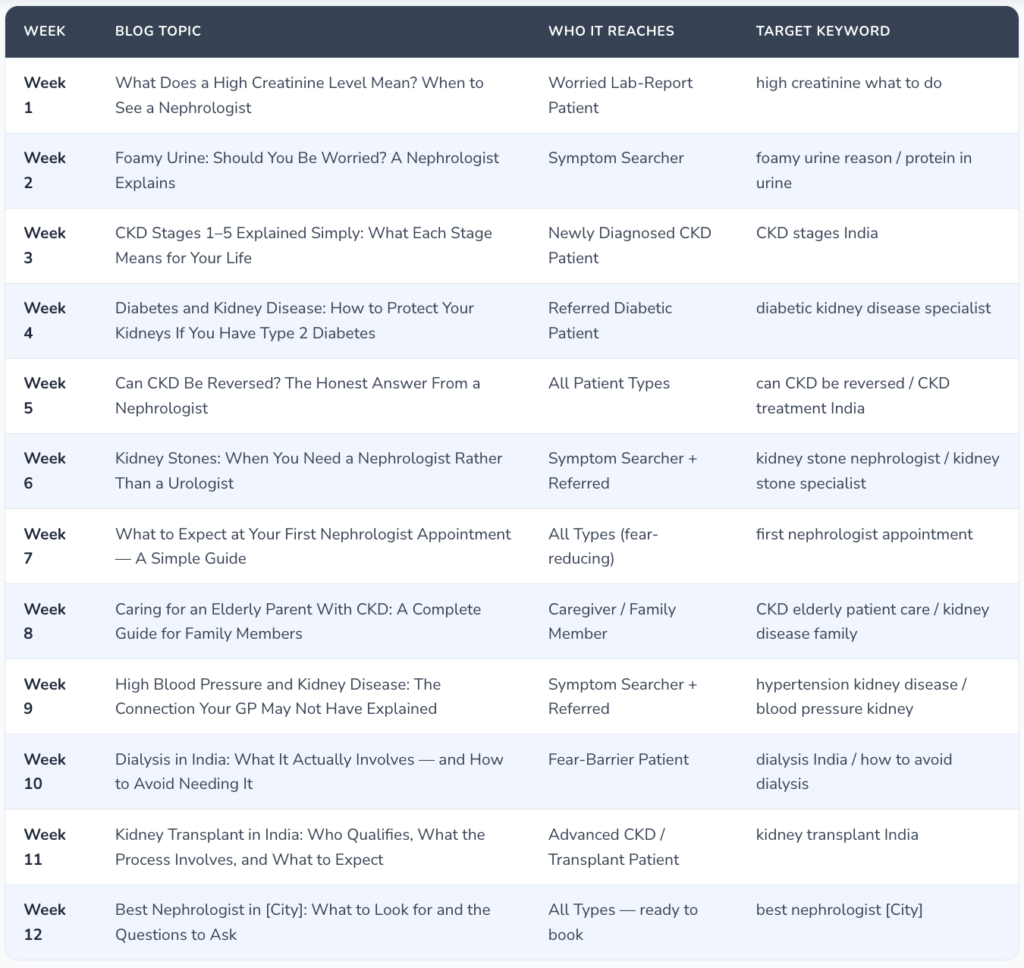
Content marketing is the strategy that keeps working long after you publish it. A good blog post about creatinine levels can bring new patients to your website every month for three years without any ongoing cost. Here is exactly what to write and where to post it.
Your 12-Topic Content Calendar — 3 Months of Blog Posts
Social Media — Simple Platform Guide
-
Facebook — Best for Caregivers and Older Patients
Post 4 times per week. Best content: CKD management tips for families, kidney-friendly diet guides, World Kidney Day content (second Thursday of March), patient education posts. Monthly “Ask the Nephrologist” Live session — announce 5 days in advance. This audience responds best to educational, caring, family-oriented content.
-
Instagram — Best for CKD Education and Younger Patients
Post 4–5 times per week. Best formats: myth vs. fact carousels (“You don’t need dialysis just because you have CKD”), kidney-friendly diet infographics, short Reels answering the questions patients Google most, World Kidney Day campaign posts in March.
-
YouTube — Best for Building Deep Trust
Post 2 videos per month. Best topics: “What does a nephrologist actually do?”, “Understanding your CKD blood test results”, “Kidney diet basics for Indian patients”, “Dialysis — what it really involves and how to avoid it.” YouTube videos rank in Google search results and bring patients to you for years after publishing.n
-
LinkedIn — Best for Referral Network Visibility
Post 2–3 times per week. Your audience is GPs, diabetologists, cardiologists, and fellow specialists. Share clinical updates, guidelines for CKD management in diabetic patients, nephropathy developments, and professional insights. Referral relationships built on LinkedIn translate directly to patient volume over 3–6 months.
Google Ads — Simple Campaign Structure That Actually Works
Google Ads bring immediate new patients while your SEO and content build over months. But only when set up correctly. The most common mistake is running one generic campaign for “nephrologist [City]” and hoping it covers all your patient types. It does not.
| Campaign | Target Keywords | Landing Page | Key Message |
|---|---|---|---|
| Campaign 1 — CKD / General | “nephrologist [City],” “kidney specialist near me,” “CKD specialist [City]” | Homepage or CKD service page | “Protect Your Kidneys. Early Care Changes Everything.” |
| Campaign 2 — Diabetic Nephropathy | “kidney specialist for diabetes,” “diabetic nephropathy treatment [City],” “nephrologist for diabetic” | Diabetic nephropathy condition page | “Diabetic? Protect Your Kidneys Before Problems Develop.” |
| Campaign 3 — Kidney Stones | “kidney stone specialist [City],” “nephrologist for kidney stones,” “recurring kidney stones doctor” | Kidney stones condition page | “Recurring Kidney Stones? Find the Root Cause with a Specialist.” |
| Campaign 4 — Transplant / Advanced CKD | “kidney transplant specialist [City],” “pre-transplant evaluation,” “second opinion nephrologist” | Kidney transplant service page | “Expert Kidney Transplant Evaluation and Post-Transplant Care.” |
-
Do not run Google Ads until your landing pages are ready. Paying for traffic to a slow, generic homepage is the single most common and expensive mistake in nephrology digital marketing. Each campaign above needs a dedicated, fast, mobile-optimised page before you switch it on.
Patient Retention & Reviews — The Two Things That Compound Over Time
CKD is a lifelong condition. A patient who trusts you at Stage 2 may be your patient for 20 years. Getting retention right — keeping patients engaged, reducing “lost to follow-up” rates, and building a review profile that converts new patients — is the highest-ROI marketing investment in nephrology.
-
Your Review Generation System — 3 Simple Steps
Step 1: Get your Google review short link from your Google Business Profile dashboard.
Step 2: Create a WhatsApp message: “Thank you for visiting us today. If you had a positive experience and have a moment, we’d be grateful for a Google review — it helps other kidney patients find quality specialist care: [link]”
Step 3: Send it to every patient at their peak positive emotional moment — after good lab results, after a reassuring consultation, or at a 3-month review milestone. Set a team target of 4 new Google reviews per week.
Simple Patient Retention Automation

Your 90-Day Action Plan — Week by Week, Step by Step
Every strategy in this guide is now broken into specific weekly tasks. Work through these in order. Do not skip ahead to paid ads before your foundation is ready.
Your 90-Day Week-by-Week Marketing Roadmap
Everything above is strategy. This is execution. Work through every item in sequence — do not skip ahead, do not run ads before your foundation and content are in place.
Week 1 — Foundation & Audit
Understand where you are before spending anything
Weeks 2–3 — Content Launch & Referral Outreach
Start building your two most important long-term patient channels
Weeks 3–4 — First Google Ads Campaign
Launch paid advertising only once your landing pages are live
Month 2 — Scale What Is Working
This month’s goal: Review what Month 1 generated. Double down on what is working. Add one new Google Ads campaign.
Month 3: Optimise and Build the System
This month’s goal: Measure everything against your Week 1 baseline, lock in what works, and plan the next 90 days based on real data.
India’s Only Digital Marketing Agency That Works Exclusively With Healthcare Practices
For nephrologists specifically, we bring genuine depth. We understand the CKD denial barrier and how to reduce it through marketing. We know the symptom-first search journey of kidney patients. We build referral systems that work for the multi-source nature of nephrology patient acquisition. We write YMYL-compliant kidney health content that Google trusts. And we understand India — Practo, JustDial, WhatsApp, Hindi content, and the patient behaviours specific to your market.
Most importantly — you will never need to explain your specialty to us. We already understand the difference between GFR and creatinine, why diabetic nephropathy is your most common referral source, and why a patient who hears the word “nephrologist” immediately thinks “dialysis.” We build your marketing around that understanding from day one.
SEO for Nephrology Practices
Three-stage symptom-to-specialist keyword architecture, CKD condition pages, YMYL-compliant kidney health content, local 3-pack ranking for every condition you treat.Social Media Marketing
Fear-reducing content calendars, CKD myth-busting carousels, World Kidney Day campaigns, caregiver-targeted Facebook content — all with the sensitivity kidney health requires.Google & Meta Paid Ads
Condition-separated campaigns for CKD, diabetic nephropathy, kidney stones, and transplant — each with dedicated landing pages and monthly ROI reporting.Website Design for Nephrologists
Fear-reducing UX, condition service pages, symptom-first content architecture, WhatsApp booking, Practo integration, and schema markup built in from day one.Your 90-Day Action Plan — Week by Week, Step by Step
Somewhere in your city right now, a patient just received a blood test showing elevated creatinine. They have typed “high creatinine what to do” into Google. They are scared and confused. Whether they find your practice — or your competitor’s — depends entirely on whether you have content that meets them at that moment.
Another patient has been told by their diabetologist that they need to see a nephrologist. They are looking you up on Google before they call. The quality of your review profile, the warmth of your website, and the clarity of your fear-reducing messaging will determine whether they confirm the appointment or look for someone else.
This plan gives you everything you need to win both of those patients consistently. Start with Week 1 of the roadmap. Do not try to do everything at once. Do one thing per day, track your results every Monday, and within 90 days you will have a marketing system that generates new kidney patients predictably. And if you would rather have a team handle all of this for you — with healthcare-specific expertise, zero learning curve on your specialty, and results you can see every month — iDigital Doctor is ready.